
Across centuries, Chinese artisans mastered techniques that transformed natural materials into art — enamel, lacquer, silk, shell, and feather. At Yanzilou, these crafts are revisited with care and context: not as nostalgia, but as living heritage. Each technique below represents a story of exchange, adaptation, and refinement — reimagined today through jewellery, textiles, and wearable art.
Cloisonné, known in Chinese as Jingtai Lan (景泰蓝), arrived from the Arabian world in the late 13th century when Mongol trade routes connected much of Eurasia. In China, it evolved into two distinctive forms — one for bronze vessels and vases, and another for fine jewellery and accessories.
Most cloisonné accessories in our collection are crafted with the Chinese filigree-soldering method, an intricate process where silver wires are hand-soldered to form each cell before the coloured enamel is applied and fired. This is similar to the Byzantine enamel tradition, now rarely practiced due to its labour intensity.
Our cloisonné pieces at the HFG Atelier studio are made with pure silver bases, gilded after enamelling. We also carry modern cloisonné-inspired pieces using copper or brass and unfired enamel paste — finished with a transparent glaze that mimics the luminous, glass-like surface of true enamel.
Visit us to view the craft and commission your own bespoke pieces.
Once known simply as Feather Inlay (点翠), this craft finds new resonance in our atelier through the inclusion of peacock feather, jewel beetle and butterfly wing materials.
These iridescent surfaces share the same light-diffusing properties once prized in kingfisher feather art, creating a modern dialogue between natural brilliance and ethical innovation.
Each piece is a meditation on transience and transformation — turning fleeting beauty into lasting adornment.
Each accessory is handcrafted, with colour options and custom designs available.
Discover our Feather & Insect Wing Inlay Collection or Contact us for custom commissions.
With over 7,000 years of history, lacquer is one of East Asia’s oldest and most enduring crafts. Chinese artisans pioneered carved lacquer (雕漆) during the Tang dynasty — building up layers of sap, then carving intricate reliefs into the surface.
Lacquer also formed the foundation for kintsugi, the Japanese art of repair, and other cross-cultural techniques.
At HFG Atelier, we repurpose vintage carved lacquer pieces into wearable forms such as necklaces, earrings, brooches, and cufflinks — preserving both their artistry and patina.
Commission your own Carved Lacquer Accessory.
Mother-of-pearl inlay (螺钿) traditionally decorates Chinese lacquerware, while in Japan it is known as Raden (螺鈿) — often woven into fabric or layered on textiles.
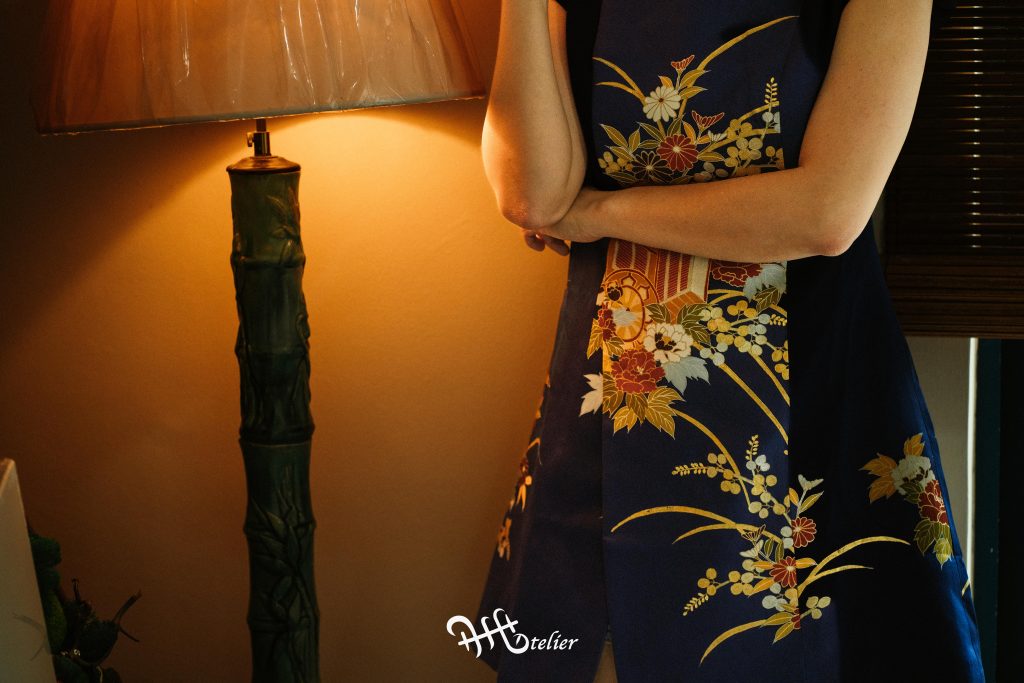
We occasionally work with vintage kimono fabrics that incorporate this delicate technique, repurposing them into unique bags and accessories. Our mock mother-of-pearl inlay pieces still use genuine shell but skip the lacquer step — instead setting the fragments with modern adhesives for flexibility and lightness.
Browse our Mother-of-Pearl Collection or enquire for a true lacquer-set commission.
Threads of light — from Chinese mulberry silk to maritime gold.
Silk and gold have always been companions in the Chinese imagination — one born of nature’s softness, the other of alchemical brilliance.
Chinese mulberry silk, cultivated for over 8,000 years, embodies a restrained radiance — soft to the touch and luminous without glare. From the Han to Song dynasties, artisans developed techniques to print, press, and paste gold onto silk, producing fabrics whose quiet shimmer prefigured later brocades. These early gold-printed silks travelled to Japan through the Tang missions, directly inspiring Nara and Heian court robes, as well as the later kinpaku (gold foil) and surihaku (gold-print) textiles used in kimono.
Centuries later, new routes brought new possibilities. Along the Maritime Silk Road, Indian zari weaving — where gold was spun into thread — reached China during the Yuan and Ming dynasties. Chinese weavers transformed the technique into their own weaved gold brocades (织金锦), a hallmark of imperial splendour from Nanjing to Suzhou.
These innovations, in turn, influenced Japanese kinran and nishijin-ori, whose refined gold weaves reflect centuries of dialogue between craft traditions. Whether gold is woven, printed, or pressed, each thread tells of exchange — not imitation, but conversation.
In our collection, Silk & Gold pays homage to this continuum: from the printed silks of Han to the maritime brocades of Ming, from Chinese looms to Japanese ateliers — a shared pursuit of radiance, texture, and time.